


Checkweighing is a critical task in any production line, so it’s important to make the right decision between dynamic checkweighers and . What’s the difference, and how do you know when you need one or the other? Adam can help.
What is Checkweighing?
Checkweighing is the practice of setting two different weight limits, one high and one lower, so you can be notified when an item being weighed is above, below or within those limits.
This function is most commonly used in quality control. For example, let’s say you produce bags of granola. You can get into legal trouble if your bags are underfilled, but you don’t want to lose money by overfilling too much. So, you set a high weight limit of 232g and a low weight limit of 223g. This way, any bag of granola 232g and heavier or 223g and lighter can be removed before going to market. They can be disposed of or sent back a step to fix the issue and try again. Meanwhile, bags that are between 226.8g and 229.6g are allowed to pass into the next stage of production.

What is a Checkweighing Scale?
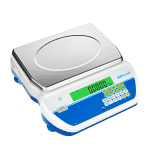
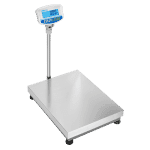
A checkweighing scale is a bench or floor scale designed for checkweighing, with features dedicated towards making checkweighing tasks easier and more efficient. These are separate from scales with a checkweighing function – those offer checkweighing, but not as their primary purpose – and often accessing the checkweighing settings takes more time.
Checkweighing scales are static, meaning they don’t move or act on their own. A person must place and remove items from the pan manually.
Adam offers many dedicated checkweighing scales, including and . In general, they don’t take up too much space, and Cruiser CKT are even portable with their internal rechargeable batteries. can be quite large, but in general they’re easily repositioned and transported.
Typical Features
The dedicated features that checkweighing scales offer often include:
- Colour-changing backlights for over (red), under (yellow) and within (green) limits
- Audible alarm option
- Buttons dedicated to accessing the high and low limit settings quickly
- Full numeric keypad for typing in custom weight limits
- Commonly portable with rechargeable batteries
These features make frequent checkweighing a breeze.
What are Dynamic Checkweighers?
Dynamic checkweighers, like Adam’s new Sentinel series, don’t need any human involvement once they’re all set up to your specifications. Products move on a conveyor belt, each independently running through the built-in checkweigher. If products are within limits, they continue down the conveyor belt without interference. If they’re discovered to be above or below limits, the machine can use a pusher, air blast or sliding arm (among other options) to remove the items from the line. Failing products can be pushed into a container or diverted onto another conveyor belt for reworking or disposal.
Adam’s Sentinel SFC 200 and SFC 400 models also offer metal detecting in addition to checkweighing. This means that your production line can get two methods of quality control (weight and metal contaminants) at once!
Typical Features
Our Sentinel series is uniquely customisable for your needs, as each one is made-to-order. However, each model does feature a few commonalities:
- An elevated light tower with green, red and yellow lights to easily monitor the results from each machine at a distance
- Large touch-screen displays for a quick learning curve
- Self-learning technology to dynamically configure itself for each product you're weighing
- Incorporated conveyors that can integrate seamlessly with existing setups
Side-by-Side Comparison
|
|
Checkweighing Scale |
Dynamic Checkweighers |
|
Type of Weighing |
Static |
In-motion |
|
Size |
Typically bench or floor scales |
Requires large amount of dedicated floor space |
|
Operation |
Manual operation |
Fully automated |
|
Process |
Pass/Fail indication only |
Automatic rejection system |
|
Cost |
Lower upfront investment |
Higher upfront investment |
|
Productivity |
Best for lower volumes |
Best for medium to high-speed production |
When is a Checkweigher Scale the Right Choice?
Checkweigher scales require operators to manually place items on and off the pan and place them in suitable pass/fail locations. This takes both time and the ability to keep up, which is typically more achievable for businesses with small-scale production numbers. They’re also ideal for spot-check quality control, where only a small part of a particular batch is tested.

If your business fits that description, we recommend a static checkweighing scale. For smaller products, the Cruiser CKT Bench Checkweighing Scale is an excellent option. It offers a colour-changing backlight and audible alarm. For larger products, Adam’s GFK-Plus may be more effective. It offers large, 40mm-high digits and a colour-changing display for effective reading at a glance, with three different platform sizes from 400x300mm to 600x800mm.
When Should You Upgrade to a Dynamic Checkweigher?
It can be difficult to tell when it’s time to upgrade from static checkweighers to dynamic checkweighers. The most important sign is when your production increases so much that your operators can’t keep up with the quantity of products that need quality control checks every day, and hiring more people to cover the gap would be too costly.
A dynamic checkweigher can operate for hours without a break at the exact same pace, approving and rejecting products in seconds. Some models of the Sentinel can checkweigh up to 400 pieces per minute on one machine – this is impossible on a single checkweigher scale. Others can hold memory of up to 10,000,000 weights for traceability over time.
The operators who spent all day checkweighing can now be appointed to other parts of the production process, simultaneously saving and adding manpower.
Which Sentinel Model is Right for You?
The Sentinel series offers nine impressive models, each one unique – so how do you know which one is right for you?
Pharmaceutical
Adam’s Sentinel SPH 300 is designed for the pharmaceutical industry with its readability of 0.01g and capacity of 600g. It boasts a top speed of 400ppm, a 15.6-inch colour touchscreen and it’s compliant with pharmaceutical GMP standards. The included windshield helps prevent air turbulence and dust contamination for lighter samples.

Food
The Sentinel SFD 200 and 300 are both ideal for the food & beverage industry. They’re both rated IP65 as standard for protection against dust and water ingress. Designed for hygiene, replacement of the conveyor and belt is tool free, preventing cross contamination. To help make switching between products more efficient, you can store specifications for up to 200 different products in their 400gb memory.
Adam’s Sentinel SFC 200 and 400 Combi models are checkweighing combined with metal detecting. This is especially critical for the food and beverage industry, where the discovery of metal in a product on a store shelf could potentially put that company out of business.
Industrial
Sentinel SHC 100, 300, 500 and 600 are built for heavy-duty applications. With capacities from 15kg to 60kg and conveyor belts as wide as 600mm, these models can handle large items with ease. The SHD 100 can even operate at speeds up to 85ppm! Sentinel SHC models can either come without a rejector method as conveyor checkweighing only or it can be fitted with a roller pusher.

For durability, the Sentinel SHC models are IP54-rated as standard (IP65 optional) and constructed with a solid carbon steel frame and 304 stainless steel weighing platforms. They’re resistant to bacteria, scratches and corrosion, keeping them running smoothly for years to come.
Want help deciding between static or dynamic checkweighers? Adam is the answer. Contact us for guidance today.